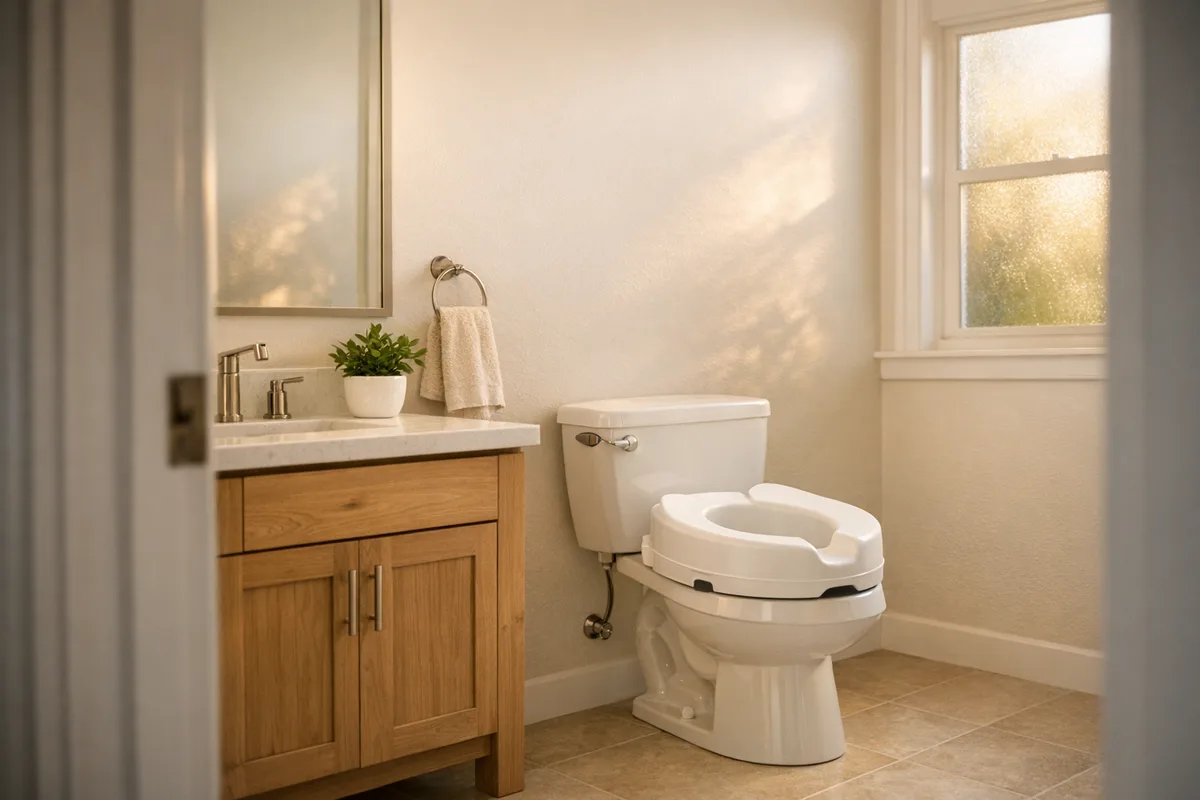
Best Raised Toilet Seats for Seniors: Safety Rails, Frames, and Comfort Picks
A raised toilet seat is one of the simplest and most impactful aging-in-place modifications you can make. The right one adds 2-6 inches of height, reduces knee and hip strain, and can include handles or safety rails for stable transfers.
Key Takeaways
- Match the seat type to the primary need: basic risers for height only, seats with arms for transfer support, or standalone safety frames when you want to keep the existing seat.
- Always verify weight capacity exceeds the user by at least 50 lbs, and confirm compatibility with your toilet shape — round vs. elongated matters.
- Most raised toilet seats install in under five minutes with no tools, making them one of the fastest safety upgrades for any bathroom.
Types of raised toilet seats and when each one makes sense
Raised toilet seats fall into four main categories, and the best choice depends on whether the user needs height, stability, or both. A basic riser clamps onto the bowl and adds 2-6 inches of height — ideal when knee or hip pain makes a standard-height toilet difficult but balance is still solid. These are the most affordable option, typically $15-$30, and work well as a first step.
Raised seats with handles add armrests to the height boost, giving the user something to push off when standing. These run $30-$60 and are the most popular choice for seniors recovering from hip replacement or managing arthritis. The handles lock into the seat frame and can usually support 250-300 lbs.
Toilet safety frames and toilet safety rails are standalone structures that bolt around or beside the toilet without replacing the seat. Frames ($30-$60) provide padded armrests at a fixed width, while rail systems ($25-$50) clamp to the bowl and offer adjustable-width support. These work well when the existing seat is comfortable and the user primarily needs something to grip during transfers.
- Basic riser: best for users who need height only and have good balance.
- Raised seat with handles: best for users recovering from surgery or managing joint stiffness.
- Toilet safety frame: best when you want armrest support without changing the seat.
- Toilet safety rails: best for compact bathrooms where a full frame would crowd the space.
What to look for before you buy
Weight capacity is the single most critical spec. Most standard raised seats support 250-300 lbs, but bariatric models go to 500 lbs or more. Choose a seat rated at least 50 lbs above the user's weight to maintain a safety margin over time. Manufacturers test to static load, not the dynamic forces of sitting down, so that buffer matters.
Toilet shape compatibility is the second factor that trips up first-time buyers. Round bowls measure about 16.5 inches from mounting bolts to front rim, while elongated bowls measure about 18.5 inches. An elongated seat on a round toilet will overhang and feel unstable. Check the product listing carefully — some seats are universal, but many are shape-specific.
Locking mechanisms vary widely. The best raised seats use a front clamp or bracket system that tightens against the bowl without tools. Avoid suction-only mounting for primary use — it can shift under load. Look for audible or tactile lock confirmation so the user knows the seat is secured before sitting.
- Verify weight capacity exceeds user weight by at least 50 lbs.
- Measure toilet bowl: round (~16.5") vs. elongated (~18.5") from bolt holes to front rim.
- Check locking mechanism type — clamp or bracket systems are more reliable than suction.
- Confirm seat height addition (2", 3.5", 4", 5", or 6") matches the user's needs.
- Look for non-slip contact pads on the underside to prevent shifting.
Our top picks across every category
We evaluated raised toilet seats across six categories: basic risers, seats with handles, toilet safety frames, toilet safety rails, padded comfort seats, and bariatric heavy-duty options. Our picks prioritize stable locking mechanisms, documented weight capacity, and consistently positive user reviews from caregivers and seniors.
Each recommendation below targets a specific use case. If you are unsure which type you need, start with a raised seat with handles — it covers the widest range of mobility levels and is the easiest to return if sizing does not work out. For users who already have a comfortable seat and primarily need something to grip, a standalone safety frame or rail system is the better investment.
Installation tips: most seats go on in under five minutes
The majority of raised toilet seats are designed for tool-free installation. Lift the existing seat and lid, place the riser on the bowl rim, and engage the locking mechanism — usually a front-mounted knob or lever that tightens against the porcelain. Toilet safety frames typically have wider feet that straddle the bowl and may include rear bracket bolts for extra stability.
Before first use, apply your full body weight to the seat while holding onto a wall or grab bar. Push laterally and rock front to back. Any movement means the lock is not fully engaged or the seat is incompatible with your bowl shape. Re-seat and re-lock before allowing the user to sit independently.
Clean the contact points between the riser and the bowl every two weeks with a mild disinfectant. Residue buildup on the locking pads can reduce grip over time. If the seat starts to shift after months of use, check the rubber contact pads for wear and replace the unit if they are compressed or torn.
- Lift existing seat and lid completely before placing the riser.
- Engage locking mechanism fully — listen or feel for the lock confirmation.
- Test stability by applying full weight while holding a grab bar or wall.
- Clean locking pads and contact surfaces every two weeks.
- Inspect rubber pads monthly for compression or tearing.
Safety considerations and when a raised seat is not enough
A raised toilet seat addresses height, but it does not solve every bathroom transfer challenge. If the user has significant upper-body weakness, a raised seat with handles may not provide enough leverage — in that case, a floor-mounted toilet safety frame or a wall-mounted grab bar beside the toilet gives a more stable anchor point.
For users with progressive conditions like Parkinson's or advanced arthritis, pair the raised seat with a grab bar positioned 6-12 inches in front of the toilet and 28-36 inches above the floor. This two-point support system — push off the seat handles, reach forward to the grab bar — creates a much more controlled stand-to-sit and sit-to-stand sequence.
If transfers are becoming consistently difficult even with support equipment, it may be time to consult an occupational therapist for a full bathroom safety assessment. A professional evaluation can identify whether a raised seat is the right solution or whether a bedside commode or higher toilet replacement would better serve the user's current mobility level.
- Pair the raised seat with a grab bar for two-point transfer support.
- Monitor for signs that the seat alone is insufficient: near-falls, heavy reliance on handles, visible strain.
- Consult an occupational therapist if transfers become consistently difficult.
- Consider a comfort-height toilet (17-19") as a permanent alternative to a bolt-on riser.
Next steps: getting the right seat in place this week
Start by measuring your toilet bowl — round or elongated — and checking the user's weight against product capacity ratings. Most of the seats we recommend ship with Prime and can be installed the day they arrive. If you are choosing between a basic riser and a seat with handles, err toward handles. The small cost difference buys significant peace of mind.
Once the raised seat is installed, walk the user through a few supervised transfers. Watch their hand placement, posture during the sit-to-stand transition, and whether they reach for anything outside the seat's support structure. If they are reaching for the vanity, towel bar, or wall, that is a clear signal you need a grab bar in addition to the seat.
Recommended Products
We may earn a commission when you purchase through these links, at no extra cost to you.
Carex Toilet Seat Riser (5.5 Inch, 300 lb Capacity)
$15-$25
No-frills height addition that locks onto round or elongated bowls. A reliable budget entry point when the user has good balance and only needs extra height.
View on AmazonDrive Medical 2-in-1 Raised Toilet Seat with Padded Arms
$35-$50
The most popular raised seat with handles on Amazon. Adds 5 inches of height with removable padded armrests and a secure locking mechanism. Fits standard and elongated toilets.
View on AmazonVive Toilet Safety Frame with Padded Armrests
$40-$55
Standalone frame that surrounds the toilet without replacing the seat. Adjustable width and height with padded armrests. Good choice when the user wants support handles but prefers their existing seat.
View on AmazonMedline Toilet Safety Rails (250 lb Capacity)
$25-$40
Compact rail system that mounts to the toilet bowl and provides adjustable-height armrests. Takes up less space than a full frame — a practical option for tight bathrooms.
View on AmazonCarex 4.5 Inch Raised Toilet Seat with Padded Arms
$45-$65
Combines height addition with foam-padded armrests for extra comfort. The padded surface reduces pressure during longer sits and feels less clinical than hard-plastic models.
View on AmazonDrive Medical Raised Toilet Seat with Lock and Lid (6 Inch, 400 lb Capacity)
$25-$40
Heavy-duty riser with a 400 lb weight capacity and a locking mechanism that grips the bowl securely. The included lid maintains a normal toilet appearance when the seat is not in use.
View on AmazonDrive Medical PreserveTech Raised Toilet Seat with Bidet
$80-$130
Premium option that combines a 4-inch height boost with a built-in bidet spray. Connects to the existing water supply line and requires no electricity. A strong pick for users who want improved hygiene without a full bidet toilet installation.
View on AmazonFrequently Asked Questions
Does Medicare cover raised toilet seats?
Original Medicare (Parts A and B) generally does not cover raised toilet seats because they are classified as bathroom safety equipment rather than durable medical equipment. Some Medicare Advantage plans offer supplemental benefits that may cover them. Check with your specific plan or ask your supplier about coverage options.
What height raised toilet seat do I need?
The right height depends on the user's leg length and mobility. A 2-4 inch riser works for most people with mild knee or hip discomfort. Users recovering from hip replacement surgery typically need 4-6 inches of added height so the hip stays above knee level when seated. Measure from the floor to the back of the knee while the user is wearing shoes to find the ideal total seat height.
Will a raised toilet seat fit my toilet — round vs. elongated?
Measure from the center of the mounting bolt holes to the front rim of your bowl. Round toilets measure approximately 16.5 inches, while elongated bowls measure approximately 18.5 inches. Some raised seats are labeled "universal" and fit both, but shape-specific models tend to lock more securely.
How do I clean a raised toilet seat?
Remove the seat from the bowl weekly and wipe all surfaces with a mild disinfectant or a 1:10 bleach-to-water solution. Pay special attention to the locking pads and underside contact points where residue accumulates. Rinse thoroughly and let it dry before reinstalling.
What is the difference between a raised toilet seat and a toilet safety frame?
A raised toilet seat replaces or sits on top of your existing seat to add height. A toilet safety frame is a freestanding structure that surrounds the toilet and provides armrests without changing the seat. Frames are better when the user's main need is something to push off of, while raised seats are better when the toilet is too low for comfortable sitting.
Can I use a raised toilet seat after hip replacement surgery?
Yes — raised toilet seats are one of the most commonly recommended post-surgical aids after hip replacement. Most orthopedic surgeons recommend a 4-6 inch riser with handles to keep the hip above knee level and reduce flexion during the recovery period. Confirm the specific height recommendation with your surgical team.
Ready to start your project?
Get matched with qualified local contractors who specialize in aging-in-place modifications.
Get My Free Quote