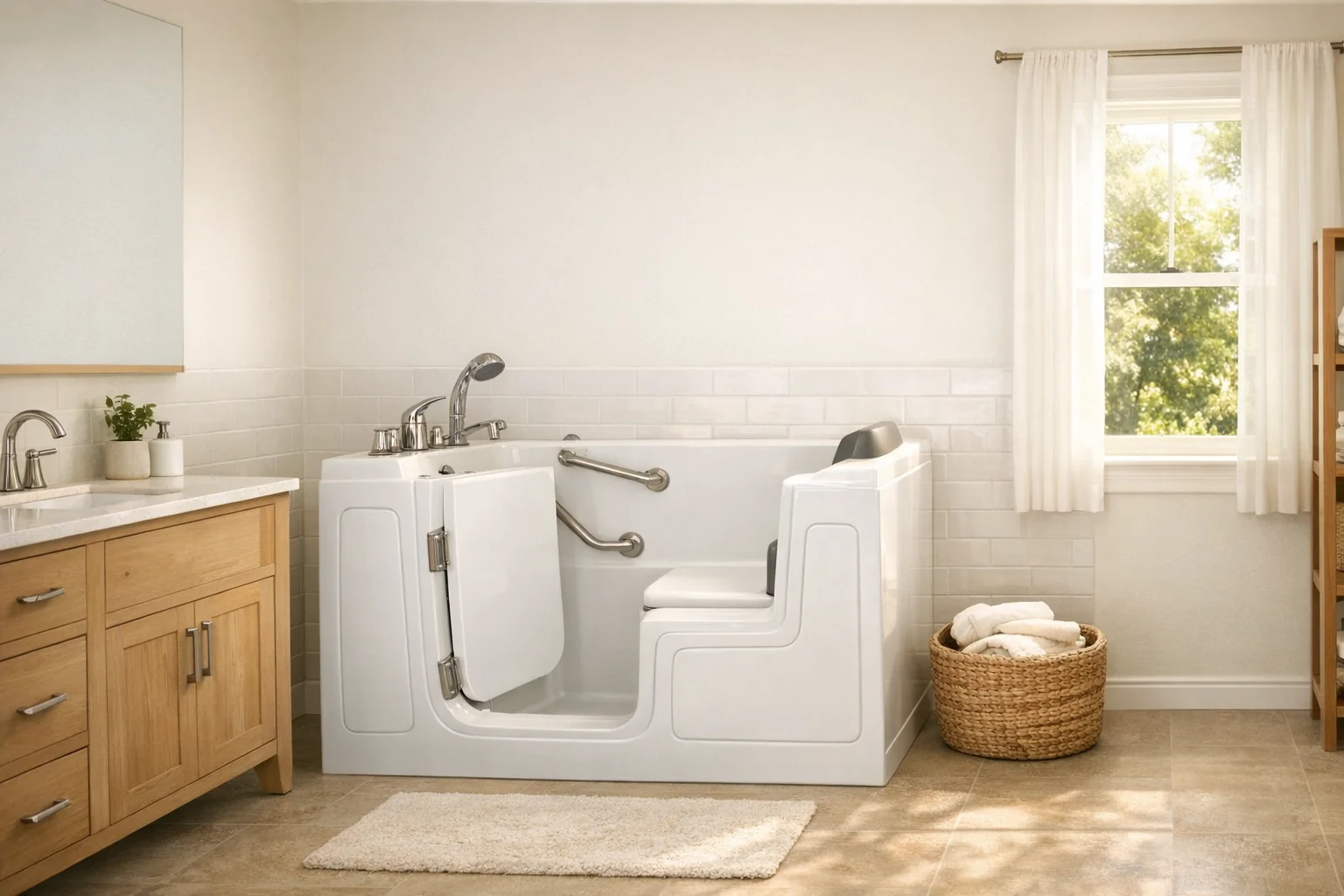
Best Walk-In Tubs for Seniors in 2026: Prices, Features, and Expert Picks
Walk-in tubs range from $1,800 budget models you install yourself to $10,000+ dealer-installed systems with hydrotherapy jets. The right choice depends on your parent's mobility level, bathroom layout, and whether you need a shower combo — not just the brand name.
Key Takeaways
- Budget walk-in tubs on Amazon ($1,800-$3,500) work well for mild mobility concerns and smaller bathrooms where a contractor install isn't practical.
- Premium brands like Safe Step and Kohler ($5,000-$10,000 installed) offer faster drains, better warranties, and professional installation — worth it for daily-use hydrotherapy.
- Always factor in installation costs ($1,500-$5,000) on top of tub price — plumbing modifications, electrical for jets, and floor reinforcement add up fast.
What is a walk-in tub and who actually needs one?
A walk-in tub has a watertight door that swings open so you can step in over a low threshold — typically 3 to 7 inches — instead of climbing over a standard tub wall. Most models include a built-in seat, grab bars, and anti-slip flooring. Some add air jets, water jets, or heated surfaces for therapeutic use.
Walk-in tubs make the most sense when someone has moderate mobility limitations but still wants to soak rather than just shower. If your parent has trouble lifting their legs over a traditional tub edge, uses a cane or walker, or has joint pain that responds well to warm water therapy, a walk-in tub can extend safe independence in the bathroom.
That said, walk-in tubs are not the right fit for everyone. You have to stand inside the tub while it fills and drains — which can take 7 to 15 minutes depending on the model. If standing for that duration is difficult, a walk-in shower with a bench seat may be a better option. If transferring in and out of any enclosed space is the core challenge, a roll-in shower is likely the right call.
Walk-in tub brand reviews: from budget to premium
The walk-in tub market splits into two tiers. Premium brands like Safe Step, Kohler, and American Standard sell through authorized dealers who handle measurement, installation, and warranty service. You'll pay $5,000 to $10,000 or more all-in, but you get professional installation, fast-drain technology, and long warranties. Budget brands like CO-Z, FerdY, and Empava sell direct on Amazon for $1,800 to $3,500, but you'll need to arrange your own plumber and the drain times tend to be slower.
Safe Step is the most recognized name in the space, with a lifetime warranty and 24/7 customer support. Their tubs start around $5,000 and can reach $8,000 depending on features. They include heated seating, micro-bubble therapy, and a wider door than most competitors. The main drawback is that pricing is only available through an in-home consultation — you cannot get a ballpark online. Kohler's walk-in bath line runs $5,000 to $10,000 and focuses on a premium feel with hydrotherapy jets, a faster drain pump, and a hand shower. Kohler baths install through their dealer network and include a one-year warranty with extended options available.
Ella's Bubbles occupies an interesting middle ground — priced between $3,000 and $6,000, some models are available on Amazon with standard shipping. Their Deluxe model includes dual massage (air and water jets), an inline heater to maintain water temperature, and a 3-inch fast drain. American Standard offers tubs in the $3,000 to $7,000 range with a focus on hydrotherapy and whirlpool features, installed through their contractor network. For budget-conscious families, CO-Z, FerdY, and Empava offer walk-in tubs on Amazon starting around $1,800 — we cover those in the affiliate picks below.
Walk-in tub with shower combo: the flexible option
A walk-in tub shower combo includes a standard shower head (usually a hand-held wand on a slide bar) mounted above the walk-in tub. This gives you the option to take a quick standing or seated shower on most days and a full soak when you want hydrotherapy. For families trying to accommodate different preferences or changing mobility levels, the combo format is the most versatile choice.
Most premium brands offer shower combo versions of their standard walk-in tubs. Kohler's walk-in bath includes an integrated shower package. Ella's Bubbles offers several combo models. On the budget side, FerdY and Empava both sell shower combo units on Amazon in the $2,000 to $3,500 range.
One practical consideration: if the walk-in tub replaces your only bathtub/shower, a combo unit is essentially mandatory. Make sure the shower wand reaches high enough for the tallest person in the household, and verify that the enclosure includes a curtain rod or splash guard — water spraying outside the tub during a standing shower is a common complaint with poorly designed combos.
- Verify the shower wand height accommodates all household users.
- Confirm the combo includes a curtain rod, splash guard, or glass panel.
- Check that the shower diverter valve is easy to operate with wet or arthritic hands.
- Make sure the drain can handle continuous shower flow, not just fill-and-drain cycles.
Walk-in tub cost: what you will actually pay
The tub itself is only part of the cost. A complete walk-in tub project typically includes the unit, delivery, plumbing modifications, electrical work (if your model has jets or a heated seat), floor reinforcement, and finish work like tiling and trim. Budget Amazon tubs cost $1,800 to $3,500 for the unit alone. Add $1,500 to $3,000 for a licensed plumber to handle installation, and you're looking at $3,300 to $6,500 total for a budget setup.
Premium dealer-installed tubs from Safe Step, Kohler, or American Standard typically run $5,000 to $10,000 all-in, with installation included in the price. This usually covers removal of the old tub, plumbing connections, electrical hookup, and basic finish work. However, if your bathroom needs significant plumbing rerouting, subfloor reinforcement (walk-in tubs are heavy — 250 to 400 lbs empty, 600+ lbs filled), or electrical panel upgrades, expect to add $1,000 to $5,000 on top of the quoted price.
Get at least three written estimates that break out tub cost, labor, plumbing, electrical, and finish work as separate line items. Watch for vague "installation included" language that doesn't specify what happens if they discover knob-and-tube wiring or rotted subfloor once demolition starts.
- Budget path: $3,300-$6,500 total (Amazon tub + licensed plumber).
- Mid-range path: $5,000-$8,000 total (Ella's Bubbles or dealer brand with standard install).
- Premium path: $7,000-$15,000+ total (Safe Step or Kohler with full installation and extras).
- Always get 3 written estimates with line-item breakouts.
- Ask what happens if hidden issues (bad plumbing, weak subfloor) are found during demolition.
What to look for when choosing a walk-in tub
Door design is the single most important safety feature. Inward-swinging doors seal more reliably because water pressure pushes the door against the seal, but they reduce interior space. Outward-swinging doors give you more room inside but depend entirely on the seal mechanism to prevent leaks. Either style works — just make sure the threshold is under 5 inches and the door handle is easy to operate with wet hands or limited grip strength.
Drain speed matters more than most buyers realize. Standard gravity drains can take 8 to 15 minutes to empty a walk-in tub, and you're sitting in cooling water the whole time. Premium models include powered drain pumps that empty the tub in 60 to 120 seconds. If your parent will use the tub daily, a fast drain is worth the extra cost — especially in cooler climates where sitting wet in a draining tub can cause chilling.
Look for ADA-compliant grab bar placement, a textured non-slip floor surface, and a seat height between 17 and 20 inches (standard chair height). If hydrotherapy is a priority, compare the number and placement of jets, whether the system includes an inline water heater to maintain temperature during long soaks, and whether the jet system is self-draining to prevent mold buildup in the lines.
- Door threshold under 5 inches with a handle that works for wet or arthritic hands.
- Drain time: gravity (8-15 min) vs. powered pump (60-120 seconds).
- Seat height between 17 and 20 inches for safe transfers.
- Anti-slip textured floor, not just a smooth acrylic surface.
- Inline water heater if you want temperature-maintained soaks.
- Self-draining jet system to prevent mold and bacteria buildup.
Walk-in tub vs. walk-in shower: which is right?
Walk-in tubs and walk-in showers solve different problems. If your parent benefits from warm water therapy for arthritis, chronic pain, or circulation issues and can stand comfortably for 5 to 10 minutes while the tub fills and drains, a walk-in tub adds genuine therapeutic value. If the primary goal is just getting in and out of a bathing space safely without climbing over a ledge, a zero-threshold walk-in shower with a bench is simpler, cheaper, and faster for daily use.
Walk-in showers cost significantly less — $1,500 to $5,000 installed for a basic barrier-free shower conversion, compared to $3,300 to $15,000 for a walk-in tub. Showers also eliminate the fill-and-drain wait time entirely. On the other hand, showers don't provide the soaking and hydrotherapy benefits that make walk-in tubs valuable for certain conditions.
Many families ultimately choose a walk-in tub shower combo as a middle ground — you get the daily convenience of a quick shower and the option to fill up for a therapeutic soak when needed. If budget allows, this is often the most future-flexible option as mobility needs change over time.
Funding, financing, and what insurance actually covers
Medicare does not cover walk-in tubs. This surprises a lot of families, but CMS classifies walk-in tubs as home improvements, not durable medical equipment. Original Medicare (Parts A and B) and most Medicare Advantage plans exclude bathroom modifications entirely. Some Medicare Advantage plans offer limited home safety benefits ($500 to $2,000/year), but these rarely cover the full cost of a walk-in tub.
Medicaid waiver programs are the strongest public funding option. Many states offer Home and Community-Based Services (HCBS) waivers that can cover bathroom modifications including walk-in tubs, but eligibility requirements, coverage limits, and wait lists vary dramatically by state. Contact your state Medicaid office directly — don't rely on manufacturer websites for eligibility information. VA Specially Adapted Housing (SAH) and Home Improvements and Structural Alterations (HISA) grants can cover walk-in tub installation for qualifying veterans.
Most premium walk-in tub manufacturers offer financing — Safe Step and Kohler both advertise monthly payment plans. Read the terms carefully: promotional 0% APR periods typically last 12 to 18 months, and the deferred interest rate can be 15 to 25% if you don't pay off the balance before the promotional period ends. If you have home equity, a home equity line of credit (HELOC) will almost always offer a lower rate than manufacturer financing.
- Medicare: does NOT cover walk-in tubs (classified as home improvement).
- Medicaid HCBS waivers: may cover bathroom mods — check your state program.
- VA SAH/HISA grants: available for qualifying veterans.
- Manufacturer financing: watch for deferred-interest traps after promotional periods.
- HELOC: usually lower rates than manufacturer financing for homeowners with equity.
Recommended Products
We may earn a commission when you purchase through these links, at no extra cost to you.
CO-Z Walk-In Bathtub with Whirlpool Jets
$1,800-$2,500
Budget-friendly entry point with air and water jets, low threshold door, and built-in seat. Best for families who want hydrotherapy without the $5,000+ dealer price tag.
View on AmazonFerdY Walk-In Tub Shower Combo
$2,000-$3,000
Combo unit with a hand-held shower wand for daily use and full soaking capability. Solid option when the walk-in tub is replacing the only bathing space in the home.
View on AmazonEmpava Walk-In Bathtub with Air Massage Jets
$2,500-$3,500
Mid-range Amazon option with air massage, chromotherapy lighting, and a fast-fill faucet. The wider door opening makes it a good fit for larger users.
View on AmazonElla's Bubbles Deluxe Walk-In Tub
$3,000-$5,500
Best overall per multiple review sites — dual massage system, inline water heater, and 3-inch fast drain. Bridges the gap between Amazon budget and dealer premium.
View on AmazonGorilla Grip Non-Slip Bath Mat
$12-$20
Essential add-on for any walk-in tub. The extra traction outside the tub door prevents slips during the step-in transition when feet are wet.
View on AmazonMoen Magnetix Handheld Shower Head
$30-$55
Magnetic docking makes it easy to detach and reattach with one hand. Pairs well with any walk-in tub that doesn't include a built-in shower wand.
View on AmazonMoen Grab Bar with SecureMount (16-inch)
$25-$45
Add supplemental grab bar support near the tub door entrance. SecureMount anchoring system installs into studs for reliable weight-bearing support.
View on AmazonFrequently Asked Questions
How much does a walk-in tub cost installed?
Budget Amazon models (CO-Z, FerdY) cost $1,800-$3,500 for the tub plus $1,500-$3,000 for professional installation, totaling $3,300-$6,500. Premium dealer-installed brands like Safe Step and Kohler run $5,000-$10,000 all-in, with installation included.
Are walk-in tubs covered by Medicare or insurance?
Medicare does not cover walk-in tubs because they are classified as home improvements, not durable medical equipment. Some Medicaid waiver programs and VA housing grants may cover part of the cost depending on your state and eligibility.
How long does the water take to drain from a walk-in tub?
Standard gravity drains take 8-15 minutes to empty. Premium models with powered drain pumps empty in 60-120 seconds. Drain speed matters because you sit in the tub waiting — a fast drain is worth the upgrade for daily use.
Can I install a walk-in tub myself?
Budget Amazon tubs are technically DIY-possible, but most installations require plumbing modifications, potential electrical work for jets, and subfloor reinforcement. A licensed plumber is strongly recommended even for budget models.
What is the difference between a walk-in tub and a walk-in shower?
Walk-in tubs offer soaking and hydrotherapy with a watertight door, but require 5-15 minutes to fill and drain. Walk-in showers are faster for daily use, cheaper to install ($1,500-$5,000), and eliminate the waiting time. Combo units offer both options.
How heavy is a walk-in tub when filled with water?
Walk-in tubs weigh 250-400 lbs empty and 600+ lbs when filled. Your bathroom floor must support this weight, so subfloor reinforcement may be needed — especially in older homes or second-floor bathrooms. Ask your installer to assess floor load capacity.
Ready to start your project?
Get matched with qualified local contractors who specialize in aging-in-place modifications.
Get My Free Quote