Best Wheelchair Ramps for Home Use: Portable, Threshold, and Permanent Options
A wheelchair ramp can be the difference between independence and isolation. The right ramp type depends on the height you need to clear, how often the ramp moves, and whether the user is in a manual chair, power chair, or scooter. Here is how to match the ramp to the situation.
Key Takeaways
- Portable folding ramps ($60-$200) handle 1-3 steps and travel. Threshold ramps ($20-$80) solve door sills and small lips under 4 inches.
- Every inch of rise needs 12 inches of ramp for safe wheelchair use. A 24-inch-high porch requires a 24-foot ramp — measure before you buy.
- Permanent ramps ($1,000-$8,000 installed) are the right call when rise exceeds 30 inches or when daily use demands something weather-proof and code-compliant.
Our top wheelchair ramp picks for 2026
We evaluated portable folding ramps, threshold ramps, suitcase-style travel ramps, and semi-permanent modular systems. Every pick below meets a minimum 600 lb weight capacity (to handle powered wheelchairs and scooters), has a slip-resistant surface, and carries at least a 4-star Amazon rating with 200+ reviews.
The right ramp type depends on two variables: how high the obstacle is and whether the ramp stays in one place. A 2-inch door threshold and a 30-inch porch are completely different problems that call for completely different products. Use the category labels below to find your starting point.
- Best portable folding ramp (short): Prairie View Industries 3ft Folding Ramp — lightweight, 800 lb capacity, fits most doorway steps.
- Best portable folding ramp (long): DMI 6ft Folding Ramp — covers 2-3 steps, durable aluminum, 800 lb capacity.
- Best aluminum multifold ramp: EZ-ACCESS TRAVERSE 8ft — commercial-grade, 800 lb capacity, folds to suitcase size.
- Best rubber threshold ramp: Ruedamann Rubber Threshold Ramp — affordable, no install needed, handles up to 2 inches.
- Best adjustable threshold ramp: EZ-ACCESS TRANSITIONS Modular Entry Ramp — adjustable height to 5.5 inches, aluminum.
- Best suitcase ramp for travel: Drive Medical Single Fold Ramp — 5ft, 800 lb capacity, folds in half with carry handle.
Types of wheelchair ramps and when each one makes sense
Portable folding ramps are the most versatile option for 1-3 step obstacles. They fold in half or thirds for storage and transport, typically weigh 10-35 lbs depending on length, and set up in under a minute. Most portable ramps use extruded aluminum with a non-skid surface and can handle 600-800 lbs. The practical length limit is about 8 feet — beyond that, the ramp gets too heavy to carry and too steep for many users without assistance.
Threshold ramps solve a different problem entirely. They bridge small height differences at door sills, sliding glass door tracks, and room transitions — typically 0.5 to 4 inches of rise. Rubber threshold ramps simply sit on the floor with no installation. Aluminum adjustable models can handle slightly higher transitions and bolt down for permanent use. These are often the cheapest and most impactful accessibility fix in a home.
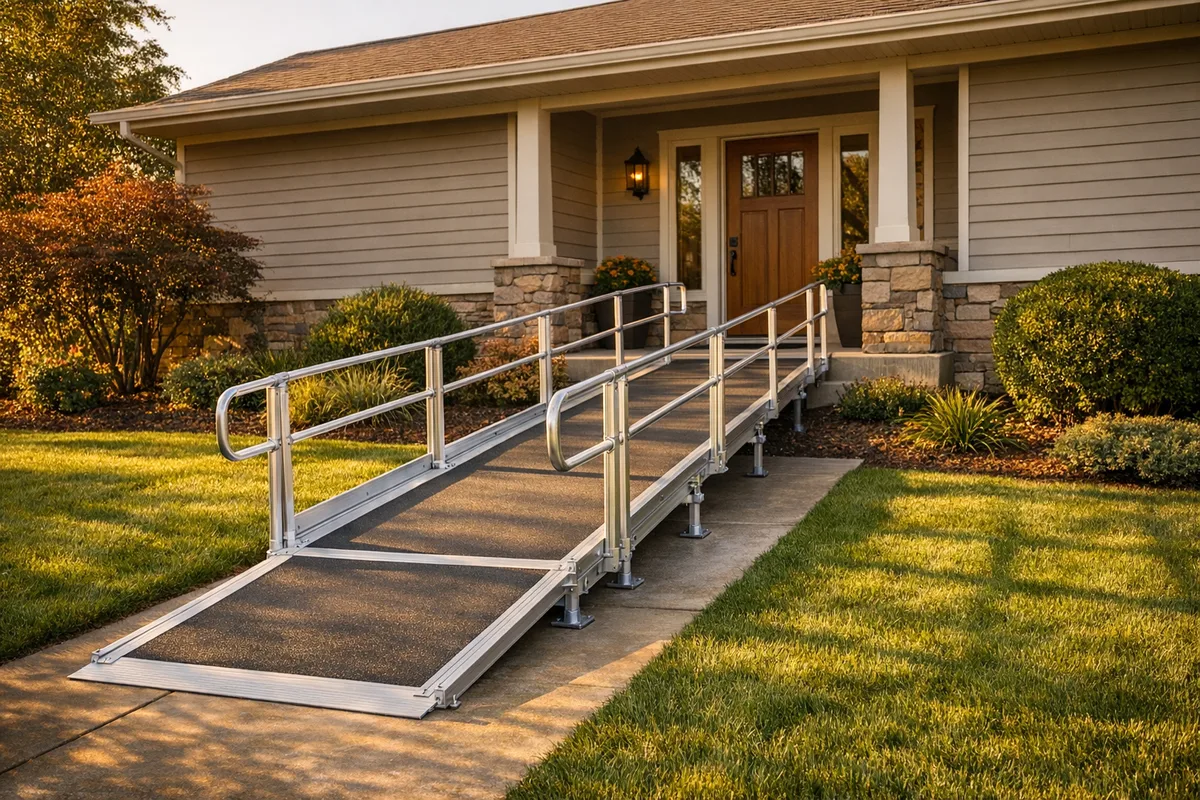
Semi-permanent modular ramp systems bridge the gap between portable ramps and contractor-installed permanent ramps. Modular aluminum systems like the EZ-ACCESS PATHWAY series bolt together without concrete footings and can be reconfigured or relocated. They handle rises up to about 30 inches and cost $300-$2,000 depending on length and configuration. For anything higher than 30 inches or requiring turns, platforms, or handrails for code compliance, a contractor-installed permanent ramp is the safer and more cost-effective long-term choice.
- Portable folding: best for 1-3 steps, travel, visiting other homes. Stores in a closet or car trunk.
- Threshold: best for door sills, sliding door tracks, and room transitions under 4 inches.
- Semi-permanent modular: best for front porches or garages with 6-30 inches of rise. No concrete needed.
- Permanent (contractor-installed): best for rises over 30 inches, daily heavy use, or code-compliant builds with handrails and platforms.
Wheelchair ramp slope guide: the 1:12 rule and what it means
The ADA standard for wheelchair ramp slope is 1:12 — one inch of ramp length for every inch of rise. A 6-inch step needs a 6-foot ramp. A 24-inch porch needs a 24-foot ramp. This ratio keeps the slope at about 4.8 degrees, which most manual wheelchair users can navigate independently and power chair users can handle safely. Steeper slopes are dangerous: a 1:8 ratio can cause a wheelchair to tip backward, and a 1:6 is essentially unusable without a winch.
In practice, many families underestimate the ramp length they actually need. Measure the total rise from ground level to the top of the threshold, not just the visible steps. A porch that looks like "three steps" is often 22-28 inches of total rise, which means an 18-24 foot ramp. If that length does not fit in a straight line, you will need a switchback or L-shaped configuration with a landing platform — and that usually means a contractor-built permanent ramp.
For short portable ramps used at a single step or threshold, a slightly steeper slope (1:8 or 1:10) can be acceptable if the user has a power chair or a strong caregiver pushing. But this is a compromise, not a recommendation. Whenever possible, stick to 1:12 or gentler, especially for manual wheelchair users or anyone propelling themselves.
- Measure total rise from ground to threshold top — include the door sill height.
- Multiply rise (in inches) by 12 to get minimum ramp length (in inches). Divide by 12 for feet.
- Example: 3-inch step = 36-inch (3 ft) ramp. 24-inch porch = 288-inch (24 ft) ramp.
- If the required length exceeds your available straight-line space, plan for switchback or L-shape with landing.
- Landing platforms should be at least 5 ft x 5 ft for safe turning and resting.
- Never exceed 1:8 slope for powered chairs or 1:10 for assisted manual chairs.
How to measure for a wheelchair ramp
Start by measuring the total vertical rise. Place a level on the threshold or top landing and extend it straight out until it clears the slope below. Measure straight down from the end of the level to the ground. This is your rise height. Do not eyeball it or estimate from step count — steps are not uniform heights, and ground may slope away from the house.
Next, calculate the run. For a 1:12 slope, multiply your rise in inches by 12. A 12-inch rise needs 144 inches (12 feet) of ramp run. Then measure the available space from the door outward. If you have a straight path longer than your required run, a single straight ramp works. If not, you need to turn the ramp with a platform landing.
Finally, check the width and clearance. ADA guidelines call for a minimum 36-inch clear width between handrails. Most portable ramps are 28-30 inches wide, which works for standard wheelchairs but may be tight for some power chairs or scooters. Measure the widest point of the mobility device including armrests and add 4 inches of clearance on each side. For permanent ramps, also confirm that the landing at the top provides at least 18 inches of clear space alongside the door swing direction so the user can open the door without backing up.
- Use a level and tape measure — never estimate rise from step count.
- Measure rise from ground level at the base of the slope to the top of the door threshold.
- Calculate run: rise in inches x 12 = minimum ramp length in inches.
- Measure available ground space from the door outward and to the sides.
- Measure the widest point of the wheelchair or scooter including armrests.
- Confirm top landing has 18+ inches clear space on the latch side of the door.
When to go permanent: materials, costs, and hiring a contractor
Permanent ramps make sense when the rise exceeds 30 inches, when the ramp will be used daily for years, or when local building codes require permits, handrails, and specific structural standards. Aluminum is the dominant material for residential permanent ramps — it will not rot, warp, or require annual staining like wood. Expect to pay $1,000-$3,000 for a professionally installed aluminum ramp under 20 feet, and $3,000-$8,000 for longer runs with landings and turns.
Wood ramps are less expensive upfront ($800-$2,500 for materials and basic labor) but require ongoing maintenance. Pressure-treated lumber resists rot but still needs sealing every 1-2 years. In wet or freezing climates, wood surfaces get dangerously slippery without non-slip treads or coatings. Concrete ramps ($1,500-$5,000+) are the most durable option but cannot be modified or relocated and require excavation and curing time.
For permanent ramp installation, always get at least three bids from contractors with accessibility project experience. Ask whether the bid includes permit filing, handrail installation, foundation or footing work, and final inspection. A ramp that is not code-compliant can create liability issues and may need to be rebuilt to sell the home.
- Aluminum: $1,000-$8,000 installed. No maintenance, relocatable with modular systems, best longevity.
- Wood: $800-$2,500 installed. Lower upfront cost, but requires sealing every 1-2 years. Slip risk in wet climates.
- Concrete: $1,500-$5,000+. Most durable but permanent and non-modifiable. Best for ground-level transitions.
- Always confirm permit requirements with local building department before construction.
- Require contractors to include handrails, edge protection, and non-slip surface treatment in the bid.
Safety considerations and ongoing maintenance
A ramp is only as safe as its surface condition and structural integrity. For portable ramps, inspect the hinge points, locking mechanisms, and non-slip surface before each use if the ramp is being repositioned regularly. Check that the top lip sits flush against the threshold with no gap that could catch a caster wheel. The bottom transition to ground should have a beveled or flared edge — a sharp drop-off at the base is a tipping hazard.
For permanent and semi-permanent ramps, inspect handrails quarterly for loosening at the posts. Clear debris, leaves, and ice from the surface promptly — even a non-slip aluminum surface becomes dangerous under a layer of wet leaves. In freezing climates, use calcium chloride (not rock salt, which corrodes aluminum) and keep a rubber-bladed squeegee at the top landing for quick clearing after snow.
If the primary user is transitioning from a manual chair to a power chair or scooter, reassess the ramp. Power chairs and scooters are significantly heavier (200-400 lbs for the device alone), which means the combined load can exceed portable ramp capacities. A ramp rated for 600 lbs that worked fine for a 180 lb person in a 35 lb manual chair may not be adequate for the same person in a 300 lb power chair.
- Inspect portable ramp hinges, locks, and surface grip before each repositioning.
- Verify top lip is flush with threshold — no gap wider than 0.5 inches for caster wheels.
- Clear debris, leaves, and ice immediately. Use calcium chloride on aluminum, not rock salt.
- Check handrail post connections quarterly on permanent ramps.
- Reassess weight capacity if the user switches from manual chair to power chair or scooter.
- Replace any portable ramp showing bent rails, cracked hinges, or worn non-slip surface.
Recommended Products
We may earn a commission when you purchase through these links, at no extra cost to you.
Prairie View Industries 3ft Portable Folding Ramp
$80-$120
Lightweight aluminum ramp that folds in half for easy storage. 800 lb weight capacity covers manual and power chairs. Ideal for a single step or low porch — the go-to starter ramp for most families.
View on AmazonDMI 6ft Portable Folding Wheelchair Ramp
$130-$200
Covers 2-3 steps at a safe slope. Folds to 36 x 15 inches for car trunk storage. Durable aluminum with non-skid surface and 800 lb capacity. The best mid-length portable option for home entry use.
View on AmazonEZ-ACCESS TRAVERSE 8ft Singlefold Ramp
$250-$400
Commercial-grade aluminum ramp for higher rises up to 16 inches. 800 lb capacity with self-adjusting bottom transition. Folds to suitcase size. Worth the premium when you need length and durability.
View on AmazonRuedamann Rubber Threshold Ramp
$20-$45
Heavy-duty rubber ramp that handles door sills and small thresholds up to 2 inches. No installation required — just place it and go. The cheapest and fastest accessibility fix for doorway transitions.
View on AmazonEZ-ACCESS TRANSITIONS Modular Entry Ramp
$45-$90
Adjustable aluminum threshold ramp for heights up to 5.5 inches. Screws down for permanent installation or sits in place for temporary use. Handles heavier power chairs better than rubber alternatives.
View on AmazonDrive Medical Single Fold Portable Ramp 5ft
$100-$160
Folds in half with an integrated carry handle for travel. 800 lb capacity and slip-resistant surface. A solid travel companion that fits in a car trunk and sets up in under 30 seconds.
View on AmazonEZ-ACCESS PATHWAY HD Modular Ramp System
$400-$1,200
Semi-permanent modular aluminum system that bolts together without concrete footings. Covers rises up to 30 inches with platform landings. Can be reconfigured or moved if needs change. The best option between portable and contractor-installed.
View on AmazonFrequently Asked Questions
What slope does a wheelchair ramp need?
The ADA standard is 1:12 — one foot of ramp length for every inch of rise. A 6-inch step needs a 6-foot ramp. A 24-inch porch needs a 24-foot ramp. Steeper than 1:8 is unsafe for most wheelchair users.
How long of a ramp do I need for 3 steps?
It depends on total rise height, not step count. Measure from the ground to the top of the landing. Three standard steps are typically 21-24 inches of rise, which means you need a 21-24 foot ramp at a 1:12 slope.
Does Medicare pay for wheelchair ramps?
Standard Medicare does not cover wheelchair ramps. However, some Medicaid waiver programs, VA grants (like the HISA grant), and state-level aging services programs can help cover costs. Check with your local Area Agency on Aging for available funding.
Portable vs permanent ramp — which is better?
Portable ramps work best for 1-3 steps (under 12 inches of rise) and situations where you need to move or store the ramp. Permanent ramps are better for higher rises, daily use, and when building codes require handrails and platforms.
What is the weight capacity I need for a wheelchair ramp?
Add the user's weight plus the wheelchair or scooter weight, then add a 50 lb safety margin. Manual chairs weigh 25-40 lbs; power chairs weigh 150-400 lbs. Most quality portable ramps support 600-800 lbs combined.
Can I install a wheelchair ramp myself?
Portable and threshold ramps need no installation — just position and use. Semi-permanent modular systems can be DIY with basic tools. Permanent ramps typically require a contractor for footings, handrails, and code compliance.
Ready to start your project?
Get matched with qualified local contractors who specialize in aging-in-place modifications.
Get My Free Quote